
Constantin Nitsche Les mains
For Constantin Nitsche, painting begins with an impossible gesture: trying to hold on to something that continually escapes. ‘Sometimes I come very close, and that’s where the satisfaction lies. You’re this close, and then it’s like sand in your hand – you try to hold onto it, but it slips away,’ he says. His second exhibition at the gallery, Les mains, takes its title from one of Franz Kafka’s letters to Milena Jesenská, in which he writes, ‘I can’t hold enough of you in my hands’ [Ich kann doch nicht genug von Dir in Händen halten]. For Nitsche, the sentence echoes the experience of painting: every image approaches something it can never fully possess.
Developed in his studio in Marseille, the works are created through a process of layering, revision and subtraction. Earlier states of the paintings are not always entirely erased, often surviving as ghostly traces beneath the surfaces. An initial idea gradually gives way to something less predictable, as the work begins to determine its own course. The artist follows as much as he directs. A painting reaches its final form through restraint: the moment at which another gesture would diminish rather than deepen what already exists on the canvas. This is evident in Nature morte au melon, where foreground, background and the printed tablecloth seem indivisible.
Kafka has accompanied Nitsche since adolescence. What continues to resonate is the instability of his writing, where certainty is constantly unsettled and meaning shifts from one sentence to the next. This openness runs through the paintings. The images appear to be suspended, resisting fixed identities or stable narratives. Les mains moves between self-portraiture, still life and fragments of everyday life. Observation and invention are never fully separated. The paintings remain rooted in reality while gently loosening its logic.
This atmosphere owes as much to childhood as it does to literature. The German fairy tales that Nitsche grew up with — in which beauty and violence exist side by side and wonder is rarely free from unease — are another reference point. Beneath the calm surfaces of the works lies an awareness that even the most mundane things can be surprisingly charged, unknowable even. Melancholy, humour and tenderness coexist, while meaning accumulates through sustained looking.
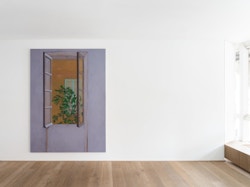
Followers of Nitsche’s work will recognise motifs that return not only in Les mains but across his wider oeuvre. Plants, interior decor and domestic objects recur altered by repetition, memory and circumstance, each painting approaching familiar subjects from a slightly different direction. In this exhibition, the Ficus plant, seen in earlier works, appears in La Visite VI. A yellow floral screen and a crystal ball link the latter work with La Canicule III. Pink flowers blossom across numerous canvases while the artist’s wife, a constant presence in his work, is the protagonist throughout. The paired paintings Les mains and La main, which speak to the exhibition title, mirror one another. In one, she holds the recognisable pink flower; in the other, a red flower resting on a table reappears in the hand of the artist. Together, they suggest not possession but exchange. Elsewhere, the Mediterranean landscape surrounding Marseille enters the studio. L’horizon (Février) observes the sea at a particular time and from a specific vantage point, while Le Roucas Blanc II begins in observation before becoming, via the act of painting, something new altogether.
Among the works is a self-portrait of the artist as Pinocchio, with a wooden nose and an oversized hat. The figure is at once candid and performative, recognisable yet faintly disguised. Nitsche has long been fascinated by the story of Geppetto and the human puppet. Here, the motif alludes to the paradox of self-portraiture. Although we tend to read such paintings as authentic likenesses, they are also acts of construction. In this work, the artist stands before one of his favourite paintings, James McNeill Whistler’s Nocturne in Black and Gold — The Falling Rocket (c. 1875; Detroit Institute of Arts). The dying fireworks in the latter work subtly reflect the idea of transience and the self-portrait’s own passage through time: the longer it remains in the studio, the less fixed the likeness becomes. Looking turns into searching; certainty gives way to revision. By the time Nitsche finishes the painting, he too has changed. The portrait no longer captures a single moment, but the period that has elapsed between its beginning and its completion.
Les mains unfolds through these subtle shifts, where images are elusive and open to interpretation, like suspended moments without a clear beginning or end. Rather than attempting to possess the world, the paintings remain attentive to what continually slips beyond reach.

Constantin Nitsche (b. 1987, Ludwigshafen, Germany) lives and works in Marseille. He studied painting at the Kunstakademie Düsseldorf. Selected institutional exhibitions include La Valse des fleurs, Collection Lambert, Avignon, France (2025); Blauregen, La Traverse, Marseille, France (2022); VIOLETTE, O-Town House, Los Angeles, CA, USA (2021); Everything is Personal, TRAMPS, New York, NY, USA (2020); Untitled, Parkhaus im Malkastenpark, Düsseldorf, Germany (2019); and Salon des Amateurs, TRAMPS, London, UK (2018).

In the Studio
Constantin Nitsche filmed in his studio in Marseille, France.
Related exhibition
Selected works

![]()
Les mains, 2025-2026

![]()
La main, 2025-2026

![]()
Étude pour la main, 2025-2026

![]()
L'horizon (Février), 2025-2026

![]()
Blütelchen, 2025-2026

![]()
Les pieds du papillon, 2025-2026

![]()
Pinocchio, 2025-2026

![]()
Nature morte au melon, 2025-2026

![]()
La Visite VI, 2025-2026

![]()
Le Roucas Blanc II, 2024-2026

![]()
Porcelet, 2025-2026

![]()
La Canicule III, 2025-2026

![]()
Étude pour une nature morte, 2025-2026


