Lesley Vance
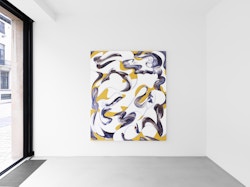
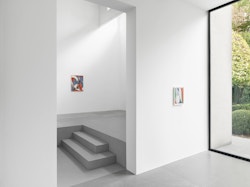
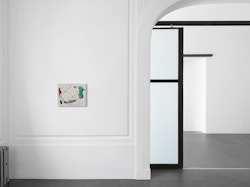
Xavier Hufkens is pleased to present a major solo exhibition by American artist Lesley Vance (b. 1977, Milwaukee, WI), marking her largest exhibition in Europe to date. Spanning the gallery's St-Georges space, the exhibition brings together a substantial body of new oil paintings and watercolours. Her sixth exhibition with the gallery offers an expansive view of Vance's evolving exploration of colour, form and the possibilities of abstraction.
There is something strangely familiar about Lesley Vance’s paintings, even when nothing in them can be named. Their sinuous, interlocking forms suggest petals, folds of fabric, fragments of bodies or objects glimpsed at close range, yet none of these associations quite holds. At the heart of Vance’s practice is a sustained questioning of the boundaries between abstraction and representation; she has described her work as “representational painting of something abstract”. Equally resonant is Arthur Dove’s ambition to “create something unrecognisable yet as certain as the letter A”. Vance’s paintings pursue a similar paradox: giving form to something that does not exist, yet somehow feels grounded in reality.
In her most recent paintings, Vance continues to test the possibilities of her pictorial language, often through a more condensed and formally restrained approach. Translucent passages, opaque planes of colour and sculptural shapes that seem to fold, twist or float in indeterminate space create arrangements of varying density and complexity. Each work establishes its own chromatic and spatial conditions. Yet across these variations, a recurring concern with movement and duration persists. Vance describes the circular energy of her compositions as a means of evoking infinity, “a suspension of time” in which forms seem poised between stillness and an ongoing process of transformation.
Despite their intricate construction, these paintings emerge through a highly intuitive process. “I don’t make studies; I can’t plan it ahead of time,” Vance explains. Working directly with slow-drying oils, often over several months, Vance allows each work to develop through successive decisions, responding to what unfolds on the canvas. Yet this openness to improvisation is balanced by remarkable precision and a set of self-imposed rules, which she continually tests, revises or abandons. For instance, while she once concealed the beginnings and endpoints of her sweeping forms to preserve a sense of continuous movement, she now allows certain gestures to come visibly to a halt. What appears spontaneous is the result of a sustained negotiation between intuition and control, chance and precision.
Such experimentation is informed by an active dialogue with other artists and visual traditions. Vance approaches painting as part of a wider artistic lineage, openly acknowledging the influences that shape her practice, from the interlocking planes of Juan Gris and the organic forms of Georgia O’Keeffe, Anna Zemánková and Carla Accardi to the collaged imagery of Lee Krasner. An avid collector of ceramics, artworks and other objects, she is equally drawn to the formal peculiarities of things encountered in everyday life, finding in them unexpected possibilities for her own pictorial language.
Alongside the oil paintings, the exhibition includes new paintings on paper. Made with watercolour, they offer a more immediate engagement with pigment. Translucent washes, visible brushstrokes and areas of exposed paper become integral to the compositions, revealing another dimension of Vance’s exploration of colour and form. Simultaneously, these works reflect her evolving approach to experimentation: for the first time, she has limited herself to just two colours per composition. This has introduced a new constraint through which to explore the possibilities of the medium, allowing for a more direct translation of her formal and colour sensibilities into concrete imagery.
For Vance, a painting ultimately arrives at a state in which it seems to possess a necessity of its own, as though it could exist in no other way. What begins as an open-ended process of experimentation gradually becomes a self-contained world, one that escapes even the artist’s grasp. As she reflects: “You think the more you work on something, the more you know it. But the more I work on my paintings, the less I know them. They become their own reality apart from me.”

Lesley Vance (b. 1977, Milwaukee, WI) lives and works in Los Angeles. Her work is held in major public collections: San Francisco Museum of Modern Art, San Francisco; Metropolitan Museum of Art, New York; Dallas Museum of Art, Dallas; Milwaukee Art Museum, Milwaukee; Museum of Contemporary Art, Los Angeles; The Museum of Modern Art, New York; Los Angeles County Museum, Los Angeles; Walker Art Center, Minneapolis; and The Whitney Museum of American Art, New York, among others.

In The Studio