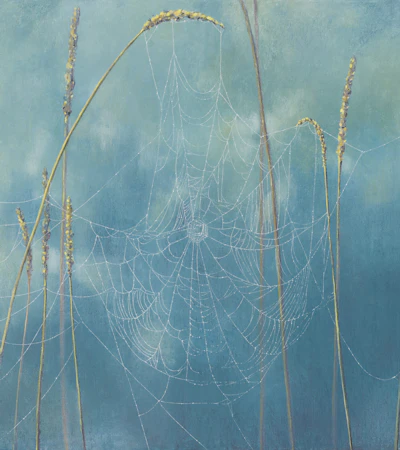
Nicolas Party Toile d’araignée
“But the image of the dead, which memory preserves for us for a time, gradually alters, slowly decays within us, like a pastel left unprotected by glass, whose dust evaporates. And within us, our dead die a second time!”
Georges Rodenbach, Bruges-la-Morte
(1892)
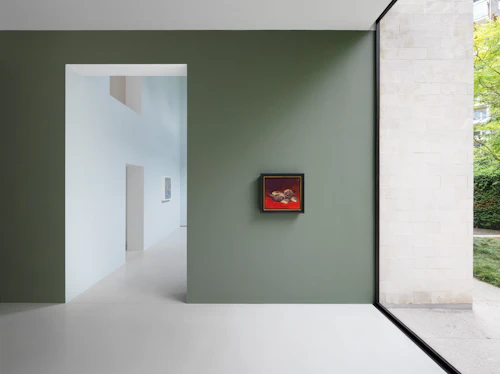
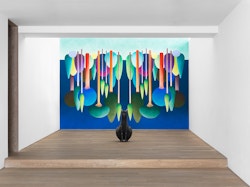
In his fourth exhibition with Xavier Hufkens, entitled Toile d’araignée [spider web], Nicolas Party presents five distinct groups of works, each occupying a specific spatial and conceptual position within the galleries. Structured as a sequence of rooms rather than a linear narrative, the presentation unfolds through a series of visual and thematic correspondences. While certain motifs are familiar, others appear for the first time, marking new directions in the artist’s practice.
The opening gallery features an unprecedented ensemble of pastels based on images from the Belgian poet and novelist Georges Rodenbach’s Bruges-la-Morte (1892), a key Symbolist novel notable for incorporating photographs into the text. Through cropping and abstraction, Party shifts the focus from architectural representation towards reflection, with water occupying a central and transformational role: shapes dissolve, blur and become amorphous. Bridges, by contrast, function as stable, structural elements that anchor the compositions. Both motifs carry symbolic weight. Reflection introduces the idea of the double—an image both present and altered—while the bridge suggests passage, connection, and transition. Together, these works establish a visual framework characterised by stillness, ambiguity, and a tension between form and dissolution.
They also situate the exhibition within a broader cultural lineage. This extends from Rodenbach’s novel to later reinterpretations, including D’entre les morts [The Living and the Dead] by Pierre Boileau and Thomas Narcejac (1954), which in turn formed the basis for Alfred Hitchcock’s Vertigo (1958). Across these works, themes of doubling, repetition, and the indeterminacy of identity come to the fore. This layered genealogy informs Toile d’araignée as a whole, in which images are held in suspension—vital yet inert, visible yet vanishing—suggesting a world in which forms are continuously constructed, dissolved and reimagined.
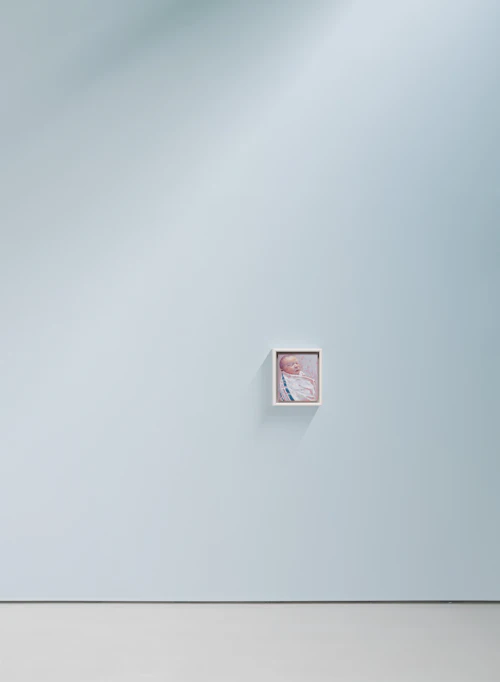
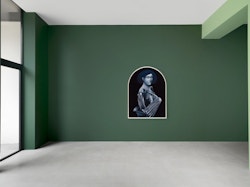
The notion of duality is further developed in the double portrait installed on the ground floor. Introducing a human yet destabilising element into the predominantly architectural and landscape-based compositions, these images mirror the blurred boundaries between life and afterlife, and between memory and reality, as found in both Vertigo and Rodenbach’s novel. They also draw on visual echoes from Ingmar Bergman’s Persona (1966), in which the merging of two faces suggests a shared or unstable identity. The film’s protagonist poses the question: ”Is it possible to be one and the same person at the same time? I mean, two people?”
A transitional space leads into a body of work depicting dead fish, a recent motif in the artist’s oeuvre. While these engage with the tradition of Dutch still life painting, they also depart from its conventional frameworks. The French term nature morte explicitly introduces the notion of death. Further reference points include the unsettling still lifes of Francisco de Goya, often understood in relation to the brutality of the Peninsular War, and the late work of Pierre-Auguste Renoir, who repeatedly returned to this motif during the First World War. Party presents the fish in indeterminate settings: removed from any recognisable environment, their bodies overlapping and clustering in ambiguous configurations. The subject hovers between materiality and symbolic resonance, resisting narrative resolution.
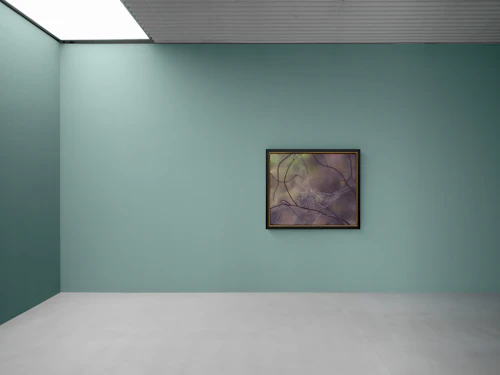
On the upper floor, a series centred on spider webs marks a further development. Depicted at daybreak, when dew renders its architecture visible, the web is shown at a precise moment of transition—just before it is disturbed or destroyed. As a structure produced through sustained labour, it exists only temporarily before being undone and rebuilt. This cyclical process reflects a broader concern with temporality and ephemerality. The spider web also functions as a metaphor for the artist’s practice, particularly in relation to pastel—a medium that is inherently fragile. These works thus foreground their own conditions of making, emphasising labour, duration and delicacy. The web can be understood as a form of inscription, recording a presence already in the process of disappearing.
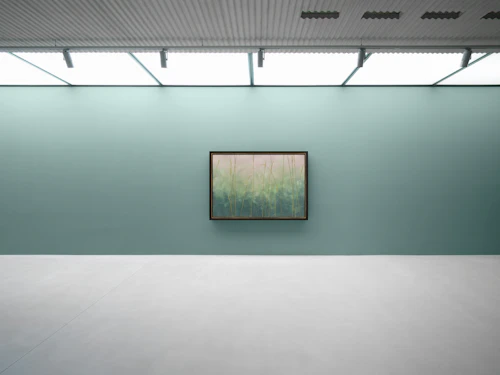
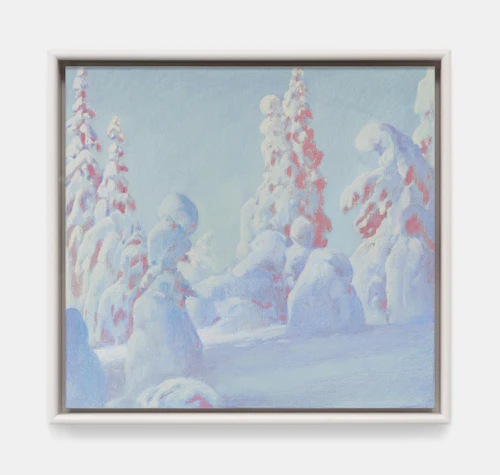
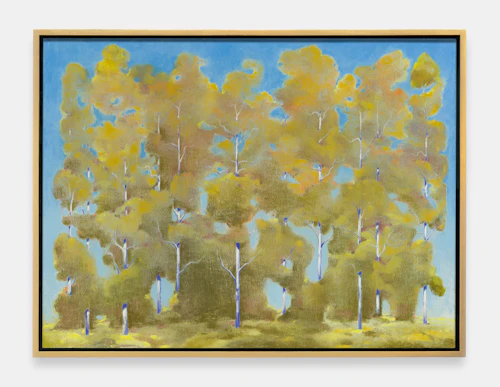
A series of treescapes, presented in the lower gallery, introduces a compositional shift. Unlike the Bruges paintings, which are defined by high horizons and compressed space, these works adopt a low perspective, allowing the sky to dominate the pictorial field. In contrast to the vivid, crisply delineated trees of earlier works, Party now turns to soft, hazy shades of green and gold. As a motif, the tree carries a long-standing symbolic association, functioning as an axis between earth and sky. Here, this verticality is expressed through a restrained visual language that emphasises stillness and openness.
As a whole, Toile d’araignée articulates an ongoing investigation into states of transition. Recurring motifs—reflections, bridges, fish, webs and trees—operate as points of passage, each engaging with the relationship between appearance and disappearance. Rather than presenting stable or resolved images, the works remain contingent, with forms continually shifting and redefined. In this way, the exhibition foregrounds the instability of the image and its capacity to hold multiple temporal and perceptual qualities. It proposes a space in which meaning is not fixed, but emerges through processes of repetition, transformation and transience, inviting close attention to the dynamics of visibility and erasure.

Nicolas Party (b. 1980, Lausanne, Switzerland) lives and works in New York. His work has been exhibited internationally including recent solo exhibitions at the Currier Museum of Art, Manchester, NH, USA (2025); Holburne Museum, Bath, England, UK (2025); Hoam Museum of Art, Yongin, South Korea (2024); The Warehouse, Dallas, TX, USA (2024); The Green Family Art Foundation, Dallas (2023); The Frick Collection, New York (2023); Museum Frieder Burda, Baden-Baden (2023), Montreal Museum of Fine Arts, Montreal (2022); Le Consortium, Dijon (2021); MASI Lugano (2021); FLAG Art Foundation, New York (2019); M WOODS, Beijing (2018-2019); and Magritte Museum, Brussels (2018).

In Focus
On the occasion of the exhibition, Nicolas Party travels to Bruges
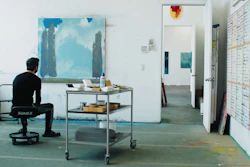
In the Studio
Louisiana Channel visits the artist’s studio in New York
Related exhibitions
Selected works

![]()
Bruges, 2026

![]()
Bruges, 2026

![]()
Bruges, 2026

![]()
Bruges, 2026

![]()
Spider Web, 2025

![]()
Double Portrait, 2026

![]()
Dead Fish, 2026

![]()
Dead Fish, 2026

![]()
Dead Fish, 2026

![]()
Dead Fish, 2026

![]()
Dead Fish, 2026
![]()
Landscape, 2026

![]()
Baby, 2026

![]()
Trees, 2026

![]()
Landscape, 2026

![]()
Landscape, 2026

![]()
Spider Web, 2026

![]()
Spider Web, 2026

![]()
Spider Web, 2026

![]()
Spider Web, 2026

![]()
Spider Web, 2026

![]()
Spider Web, 2026

![]()
Trees, 2026
![]()
Trees, 2026

![]()
Landscape, 2026

![]()
Trees, 2026

![]()
Trees, 2026