
Sayre Gomez Sim City
Sim City, Sayre Gomez’s third exhibition at Xavier Hufkens, brings together a new body of paintings, figurative sculptures, and works on paper that continue his engagement with the urban framework of Los Angeles and the mechanisms of image making. Employing various strategies of constructing and manipulating images, Sim City wrestles with representations of a city that is itself a symbol of artifice, presenting Los Angeles emerging as a cultural construction—a protagonist and backdrop, home and fantasy, paradise and myth.
At the core of Gomez’s practice lies a sustained interest in examining the foundations and history of how images are made, reproduced, dissected, reanimated and how they function in contemporary culture. His photorealistic works are painted from composite sources, borrowing from personal cell phone photos, stock photography, and found images that are often intentionally distorted with digital artefacts, and analogue camera effects such as sunbursts and the blur of a soft-focus lens. There is a repetitive folding, a push and pull, in Gomez’s paintings that embraces the liminal space between fiction and documentation within the constructed image. The works consequently produce scenes that speak to the socio-political structures of inequity that recur throughout his practice. The final manual reproduction – an airbrushed painting – returns the image to the realm of painting through techniques borrowed from commercial photo retouching and Hollywood set painting, practices historically positioned outside the conventions of fine art.
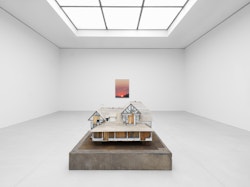
The exhibition begins with an opening tableau of two child-sized sculptures sitting on playground swings hanging from the ceiling of the gallery. Modelled after the artist’s young children, the figures assume the guise of Precious Moments figurines, the saccharine, doe-eyed miniatures popularised in the 1980s. Their sentimental, cartoon-like forms are rendered uncanny through the addition of real hair and his own children’s clothing. The introduction of these figures in Gomez’s recent work reflects his growing preoccupation with fatherhood and coming of age at this particular moment in time, within the urban realities that have long shaped his work. Behind them sits a large-scale painting depicting an incandescent orange sun setting over a city skyline. The sunset is rendered strangely indeterminate; its saturation and scale slip the scene into something foreboding. Set against this backdrop, the sculptures function as doubles – simultaneously fictional and deeply personal – occupying an uneasy space between innocence, prescience, and lived reality.
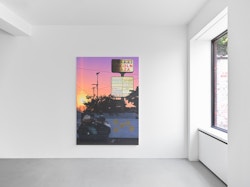
Throughout Sim City, Gomez explores the use of repetition and reproduction as a device. In Mariscos 1-3 (2026), a strip-mall sign advertising a Mexican seafood restaurant, a ubiquitous sight in Los Angeles, is used as a motif throughout the three paintings. The sign is partially shattered, revealing an empty armature reminiscent of a window frame that foregrounds three dramatically different skies. A red, fiery sunset, a purple, lightning-filled night sky, and a picturesque blue sky with puffy clouds set the stage for the alternating moods of a commonplace scene. The tones and colours in the sign shift and become embedded convincingly into their alternating environments, happy to be taking part in the ruse. Similarly, a suite of discrete paintings depicts the sun setting in the centre of an array of idealised landscapes. Each sun is marked by a celestial lens flare that could be a serendipitous photographic moment of divinity or a cliché stock photograph. The repetitive images become a film, a cut-and-paste pastiche, a comic daydream of your daily commute.
Gomez expands the relationship between reproduction and authenticity in a new series of works on paper. Rather than rendering meticulous scenes in airbrush, he uses screentone, an appliqué of clip art composed of gradients of halftone or Ben-Day dots. Historically used in commercial and industrial illustration dating back to the 1930s, screentone is perhaps most familiar from comic books. The ready-made, plug-and-play nature of this democratic visual language engages with the slippery line between trade, craft, and fine art. In addition, Gomez utilises the same plotter technology used to cut the stencils for his paintings, to sketch the foundation of his drawings, leaving space for freehand interventions. The drawings nod to the pre-production stage of Gomez’s large-scale paintings, which consists primarily of line drawing and the dissection of an image into the intricacies of its minute details. Freed from these constraints, the works on paper reveal a more carefree, insouciant side of Gomez’s practice, straddling the personal and political dimensions of his work.
Los Angeles may be the only city whose identity can be summoned through images that are almost entirely generic: a palm tree, a sunset, a stretch of freeway. Yet beneath these familiar symbols lies a city whose histories, infrastructures, politics, and climate remain inseparable from the conditions they obscure. Across Sim City, Gomez turns these images back onto themselves, revealing a landscape in which optimism and dread, fantasy and reality, coexist on the same horizon. The city emerges not as a fixed place, but as an image continually being made and remade.
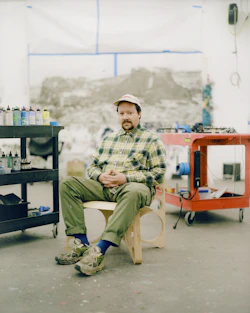
Sayre Gomez (b. 1982, Chicago, USA) lives and works in Los Angeles. A forthcoming institutional solo exhibition will be held at SITE Santa Fe (2026–27). Selected institutional solo exhibitions include Sifang Art Museum, Jiangsu, China (2022–23), and Fondazione Sandretto Re Rebaudengo, Turin, Italy (2022), among others. His work is held in major international public collections, including The Broad, Hammer Museum, LACMA, and MOCA in Los Angeles; Hirshhorn Museum and Sculpture Garden in Washington, D.C.; Whitney Museum of American Art in New York; MCA Chicago; Pérez Art Museum Miami; Moderna Museet in Stockholm; and mumok in Vienna.

Sayre Gomez in Los Angeles
A new film portrait of Sayre Gomez follows the artist through Los Angeles
Related exhibitions
Selected works

![]()
Sim City Kiosk, 2026

![]()
Sidewalk, 2026

![]()
Laid to Rest, 2026

![]()
Moses, 2026

![]()
Sim City Door (Study), 2026

![]()
Soldiers, 2026

![]()
Soldier 3, 2026

![]()
Soldier 4, 2026

![]()
Sim City 6, 2026

![]()
Cut and Paste 2, 2026

![]()
Dreams, 2026

![]()
Special Effects 4, 2026

![]()
Cut and Paste, 2026

![]()
Special Effects (Hollywood), 2026

![]()
Special Effects, 2026

![]()
Mariscos 2, 2026

![]()
Mariscos 1, 2026

![]()
Mariscos 3, 2026

![]()
Sim City Door, 2026


